How to Actually Win at Thrifting
Sorting logic, fabric tells, timing, and the search terms that get you past the noise on resale apps.
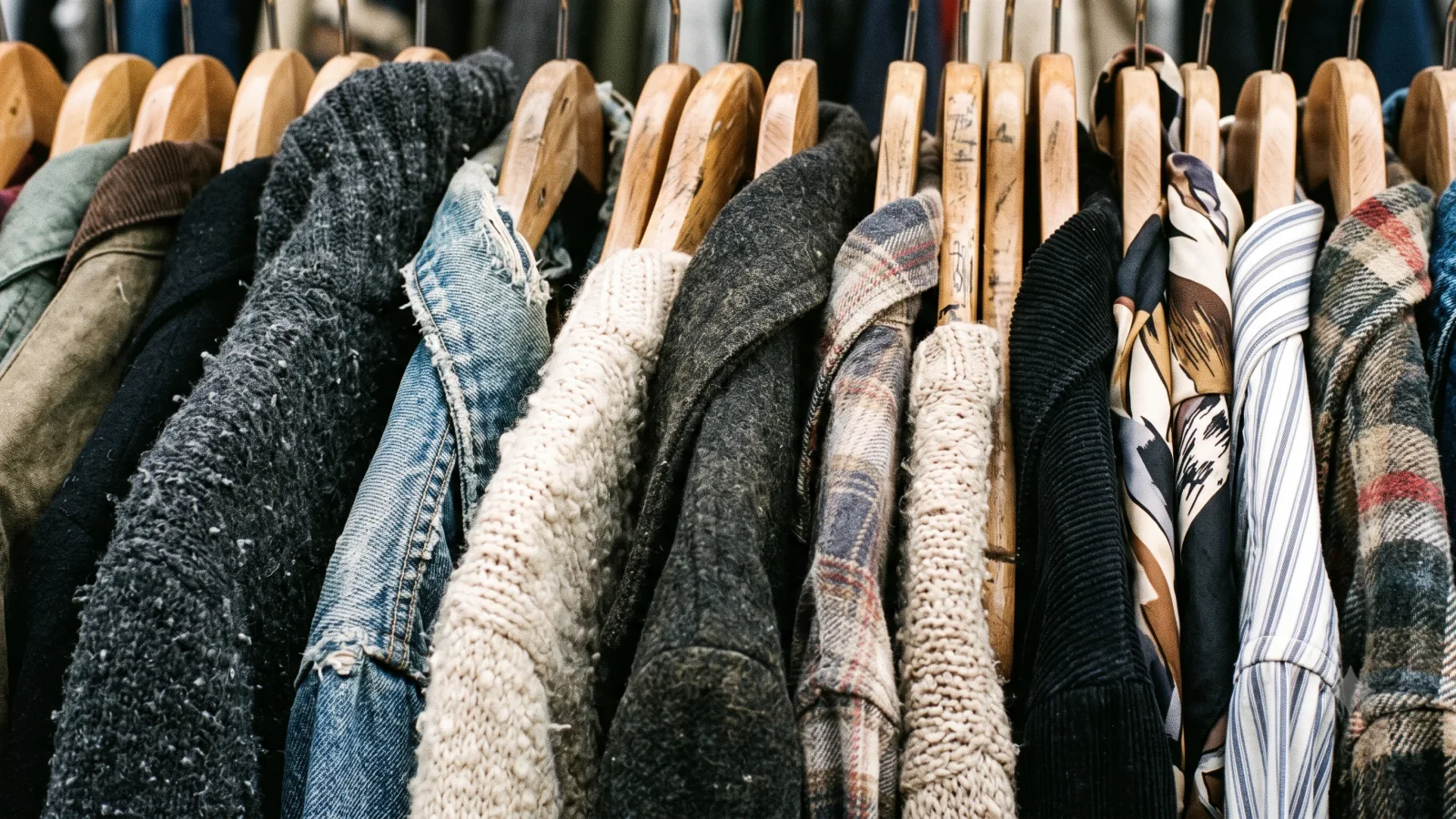
In physical stores: work the sort logic, not the racks
Most thrift stores sort by color, not category or size — which means the fastest way to waste an hour is browsing rack by rack hoping something jumps out. Two approaches beat it:
- Fabric-first scanning. Run your hand along a section of rack rather than looking at each piece. Natural fibers (wool, cotton, silk, leather) feel and hang differently than polyester blends — you'll start to feel the good pieces before you see them. This is the single highest-leverage skill in thrifting.
- Tag-checking in bulk. Once fabric-first scanning flags a piece, check the tag for fiber content and country of origin. Pre-2000s garments increasingly say "Made in USA," "Made in Japan," or European countries; a lot of manufacturing moved to Bangladesh, Vietnam, and similar in the 2000s-2010s — not a hard rule, but a fast filter.
Timing matters more than people think
Thrift stores restock continuously, and the best pieces get picked over within days. Two timing habits actually move the needle:
- Ask staff which day new donations hit the floor — most stores have a predictable restock schedule, and showing up the morning after beats a random weekend visit.
- Check back at the same store regularly rather than treating it as a one-time visit. Thrifting rewards frequency more than any single "great trip."
On resale apps: search like the algorithm isn't your friend
Depop, eBay, and Poshmark all reward listings with popular keywords, which means the obvious search terms surface the same picked-over inventory everyone else already saw. A few ways around it:
- Misspellings and abbreviations. Search brand names with common misspellings or without spaces (e.g., "carhart" alongside "carhartt") — sellers who don't know what they have often misspell the tag they're copying from.
- Material + era instead of brand. "Horsehide jacket 1960s" surfaces unbranded or misidentified pieces that a brand-name search skips entirely.
- Sort by newly listed, not relevance. Relevance sorting shows what's already gotten engagement — meaning other buyers already saw it. Newly-listed sorting gets you there first.
- Search in the destination language when possible. Japanese resale terms on sites like Rakuten or Yahoo Auctions Japan (accessible via proxy-buying services) surface vintage American workwear that made its way to Japan in bulk decades ago and is often in better condition than what's left in US circulation.
Material-plus-era searches consistently outperform brand searches for finding underpriced pieces before they get bid up.
See it in action on eBay →Know your fabric tells cold
A quick reference for the burn-adjacent (non-destructive) tells you can use in-store:
- Wool — springs back when scrunched, feels warm rather than cool to the touch, slightly fuzzy weave under close look.
- Cotton — cool to the touch, wrinkles easily and stays wrinkled, matte rather than shiny.
- Silk — has a subtle sheen that shifts as you move it, slightly cool and slippery, very fine weave.
- Polyester — feels slightly plasticky, doesn't wrinkle as readily, often has an unnaturally uniform sheen.